What Utah’s AI Prescribing Pilots Mean for Pharma Teams
A prescribing pilot and a consumer chatbot create different responsibilities. Pharma teams need a clear way to observe AI answers, review their claims and decide what to do next.

An AI answer about a medicine can be visible, persuasive and wrong in a way that matters. It might describe the wrong patient population, omit an important qualification or make a comparison the cited evidence does not support. For pharma brand, medical and regulatory teams, the practical starting point is to make those answers observable and reviewable.
Utah’s AI prescribing pilots sharpen that question, but they involve a different function. A prescribing system participates in a clinical workflow. A consumer AI answer may describe treatment without having any authority to prescribe it. The distinction affects what a company can control, what it should monitor and who needs to review a finding.
Start with what the AI actually does
Utah’s public record, checked on October 10, 2026, says Doctronic remains in Phase 1, with a licensed practitioner authorizing every renewal request. Nolla Health’s acne pilot includes first-time and refill prescriptions, with two Utah physicians reviewing every prescription before it is sent during the first stage. Later stages require written state approval. These are bounded clinical arrangements, not a general permission for chatbots to prescribe. Utah’s authorized pilot register
A renewal still requires a decision about continuing treatment. Describing it as administrative automation understates the role of clinical judgment. Likewise, accurately repeating a drug label does not establish that an individualized treatment recommendation is appropriate.
For a pharma organization, it helps to distinguish three functions:
- Information support: explaining approved information, locating a resource or helping someone prepare a question for a healthcare professional.
- Individualized guidance: using a person’s symptoms, history or circumstances to suggest what they should do.
- Treatment authorization: initiating, renewing or changing a prescription within a clinical service.
These are practical review categories, not legal classifications. Medical and legal reviewers still need to assess the actual functionality, audience, claims and applicable rules.
Separate an owned experience from an external answer
If the company operates an AI-enabled support tool, it can define the tool’s scope, review its content and establish handoffs. Teams should test whether it stays within those boundaries, including when a user asks a question the tool was not designed to answer.
If the answer appears in an independent consumer AI service, the company has a different task: observe the output, evaluate the claims and decide whether an appropriate response is available. Updating a brand website does not guarantee that a model will use it or change its answer.
Keep these two workstreams connected, but assign owners deliberately. A digital team may own a website correction. Medical and regulatory reviewers may need to assess a treatment claim. A prescribing decision belongs within the relevant clinical governance process.
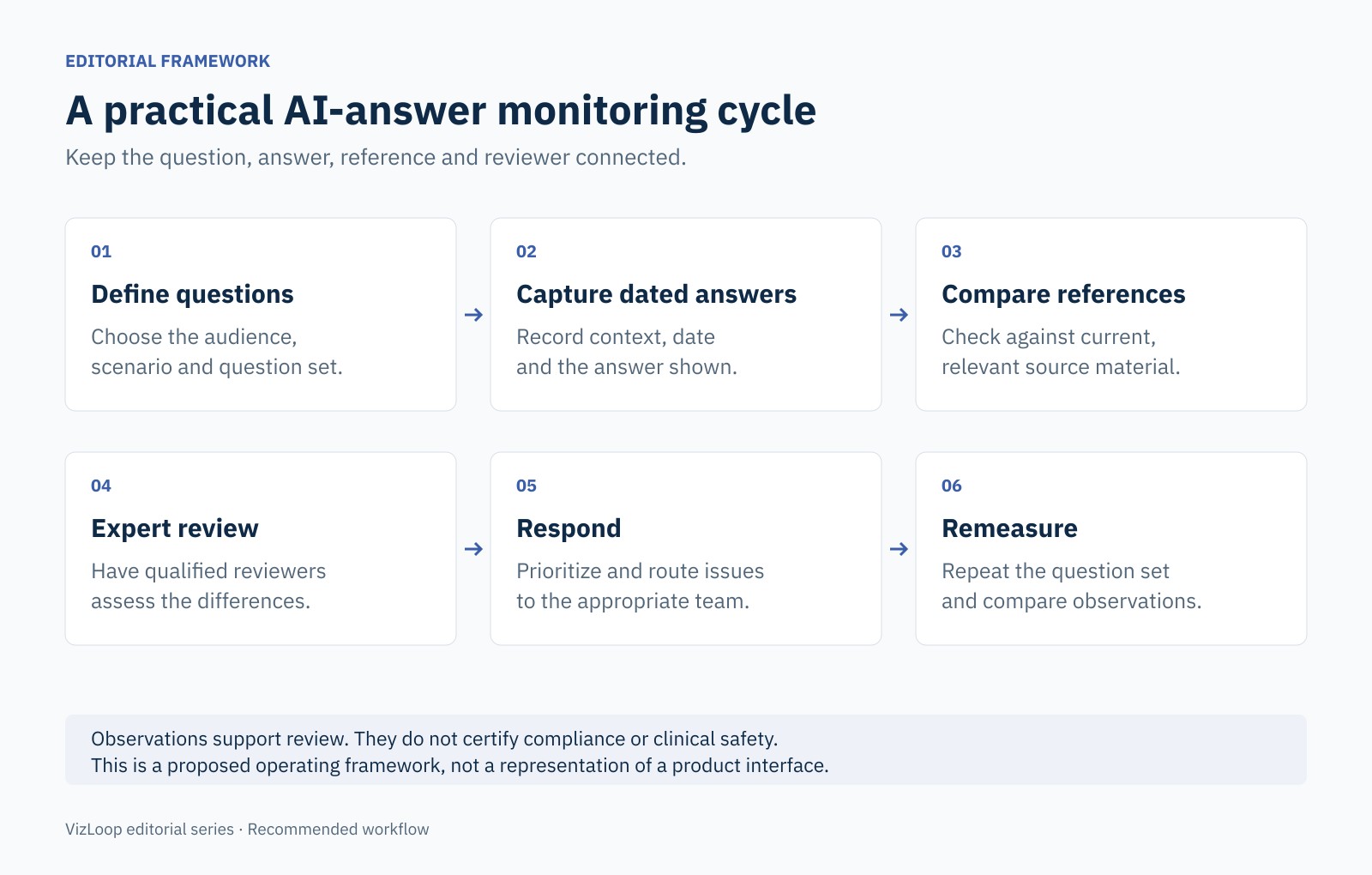
A practical AI-answer monitoring workflow connects six steps.
Full text of this figure
EDITORIAL FRAMEWORK A practical AI-answer monitoring cycle Keep the question, answer, reference and reviewer connected. 01 Define questions Choose the audience, scenario and question set. 02 Capture dated answers Record context, date and the answer shown. 03 Compare references Check against current, relevant source material. 04 Expert review Have qualified reviewers assess the differences. 05 Respond Prioritize and route issues to the appropriate team. 06 Remeasure Repeat the question set and compare observations. Observations support review. They do not certify compliance or clinical safety. This is a proposed operating framework, not a representation of a product interface. VizLoop editorial series · Recommended workflow
Choose questions with a defined business purpose
Start with a bounded set of questions about the brand, indication and treatment context. Include branded and unbranded questions, benefit and risk questions, and questions where an answer could blur the difference between general information and individual advice.
For each question, write down what the team wants to learn. Is the brand present? Is the indicated population represented accurately? Is a comparison supported? A single visibility score will not answer all three.
Assemble a dated reference set
Use the current, market-specific prescribing information and the relevant company-approved claims and supporting evidence. Record versions and effective dates so a reviewer can reconstruct what the answer was compared with.
Do not treat every item in a treatment pathway as if it has an FDA-approved product label. Nolla’s agreement, for example, includes compounded topical formulations. FDA explains that compounded drugs are not FDA-approved. Formulary or protocol alignment is a separate assessment from comparison with an approved product label. Nolla agreement, medication scope · FDA explanation of compounded drugs
Preserve the answer and its context
Keep the exact question, full answer, cited sources, service, collection date and relevant settings available for review. Record the model or version when the service exposes it. Use synthetic scenarios rather than entering identifiable patient information into public tools.
A screenshot may help a reviewer see the experience, but retain the underlying text and links too. Repeat selected queries under documented conditions to understand variation. A single answer establishes what appeared in that observation; it does not establish what every user sees.
Review the meaning of each material claim
Look beyond the presence of a brand name or a matching phrase. Review whether the answer changes the indicated population, overstates a benefit, introduces an unsupported comparison or makes a safety statement that needs qualification.
Flag differences for expert review rather than declaring them violations automatically. Missing information may have different significance in a narrow factual answer than in an expansive treatment recommendation. The question, audience and surrounding language matter.
Give each finding an owner and a response
A useful review record connects the observed statement to the reference, explains the concern and names the next step. Depending on the finding, that may mean:
- Correcting an outdated owned resource through the established review process
- Making approved information clearer and easier to find
- Asking medical or regulatory colleagues to assess an unsupported claim
- Recording a third-party answer for continued observation when no direct remedy is available
Potential safety information also needs the organization’s established assessment and escalation process. An AI-answer monitoring workflow should not be presented as a substitute for pharmacovigilance.
Remeasure without overstating the result
After an authorized content change, repeat the relevant observations and compare them with the baseline. Keep the question set and collection conditions as consistent as possible, and record any differences.
If an answer changes, report what changed and when. Do not assume the website edit caused the change. Models, retrieval sources and other conditions can also change. A stable answer on one service is not evidence of consistency everywhere.
Measure visibility and substantiation separately
Brand teams need to understand where a product appears in the questions they monitor. Medical and regulatory reviewers need to understand whether material statements are supported and appropriately qualified. Both views are useful, but neither can stand in for the other.
A concise reporting set can include:
- Visibility: brand presence within the defined sample of questions and services
- Content findings: reviewed statements requiring correction, qualification or further assessment
- Response progress: assigned findings, approved actions and unresolved questions
- Repeat observations: what changed in subsequent collections
Label these as observations from the monitored sample. They do not establish prescribing behavior, patient outcomes or commercial impact.
Where VizLoop fits
VizLoop captures dated AI answers, product mentions and cited sources, with versioned FDA label evidence for review. Teams can compare those records with their own communications, assess findings through human review and remeasure later.
The scope is specific. VizLoop does not certify compliance or clinical safety, authorize prescriptions or control third-party model outputs. Its value is helping a team see what appeared, assess the evidence and decide what to do next.
Policy details checked October 10, 2026. This article discusses monitoring and governance practices; it is not medical or legal advice.
Email subscriptions are paused. All posts remain available on the blog.