What Utah Actually Allows in AI Prescribing
Utah’s prescribing pilots have specific limits, human-review requirements and open evidence questions. Here’s what pharma teams should take from the public record.
Public records checked October 10, 2026.
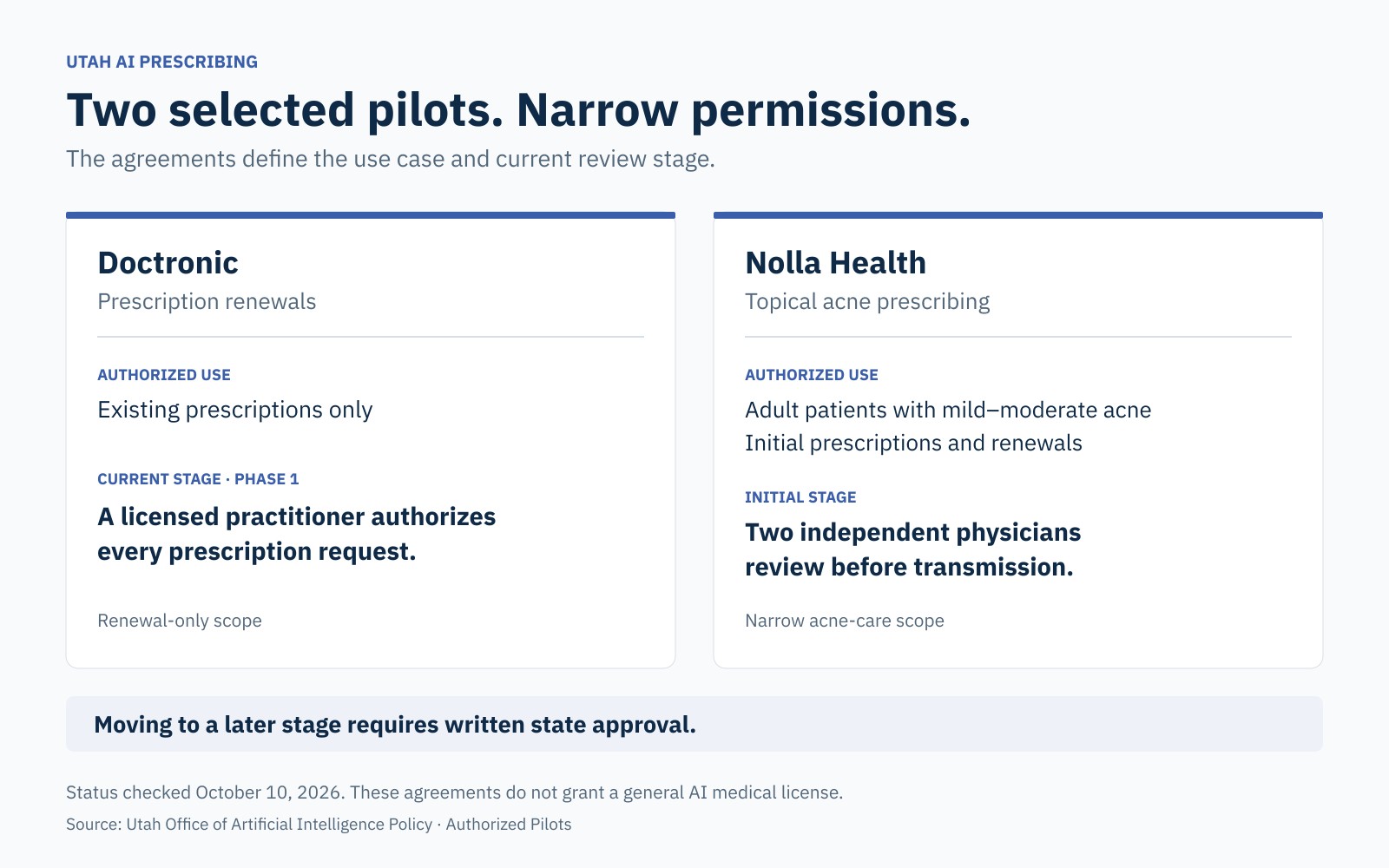
Utah is testing AI-enabled prescribing through agreements that apply to specific companies, services and conditions. The details matter: the state’s current public record says Doctronic remains in Phase 1, with a licensed medical practitioner authorizing every prescription request. Nolla Health’s newer acne pilot permits first-time prescriptions and renewals within a narrow topical-treatment protocol. Utah’s authorized pilot record
For pharma commercial, medical and regulatory teams, the useful questions are precise. What decision is being automated? Which patients and medications are included? Who reviews the decision before a prescription reaches a pharmacy? And what has the pilot actually demonstrated?
How Utah’s sandbox works
Utah’s Office of Artificial Intelligence Policy negotiates temporary regulatory relief with a participant and the relevant regulator. Each agreement applies to a defined activity. Other legal obligations continue to apply, participation does not constitute state endorsement, and the office can end an agreement. The sandbox is intended to generate evidence about how existing rules should apply to particular AI uses. Utah Office of AI Policy FAQ
This makes the agreement and its current status essential reading. A company may have permission to test a later operating model without having permission to use that model today. An announcement, a signed agreement and approval to advance a phase are different events.
For anyone summarizing the policy, a useful record has five fields: participant, permitted activity, eligible population, current oversight stage and review date. Those fields make it harder for a narrow authorization to turn into a sweeping claim as the story moves between articles, presentations and AI-generated answers.
Doctronic focuses on existing prescriptions
Doctronic’s agreement covers renewals of previously prescribed medication under its specified protocol. The scope includes 30-, 60- and 90-day renewals and excludes new prescriptions, controlled or addictive substances, and changes to treatment plans. Identity and prescription verification, escalation and reporting form part of the operating requirements. Doctronic agreement
The important status update is that Phase 2 has not been approved. The current state record also notes a 2026 amendment to the transition criteria and formulary. The listed agreement term ends October 24, 2026, so any account published after that date should check whether the agreement has been extended or changed. Current Doctronic status
Renewing an existing prescription still involves clinical judgment. In its April 20 letter, the Utah Medical Licensing Board emphasized reassessment, side effects, interactions and whether therapy remains appropriate, and recommended suspending the pilot. Commerce and licensing officials declined to suspend it, citing the physician-review requirement and other safeguards. Those documents show that the pilot’s design has been contested by medical professionals. Medical Board letter, Commerce and DOPL response
Nolla adds first-time topical acne prescriptions
Nolla Health’s agreement covers Utah adults with mild-to-moderate acne. It includes first-time prescriptions and renewals from a defined topical formulary. Oral medication, isotretinoin and severe acne fall outside the pilot’s scope. Its first stage requires every prescription to receive review from two independent Utah-licensed physicians before submission, with a minimum of four weeks and 100 patients. Later stages require written state approval. Nolla Health agreement, Schedule B and Section 20
The public record lists the pilot as active from October 5, 2026 through October 5, 2027. Nolla’s current status
The comparison is useful because the decision being tested changes. Doctronic starts from an existing prescription; Nolla’s protocol also includes selecting an initial topical treatment. Each needs to be evaluated within its own population, exclusions and review process. Those differences alone do not establish that one system is safer than the other.
Full text of this figure
UTAH AI PRESCRIBING Two selected pilots. Narrow permissions. The agreements define the use case and current review stage. Doctronic Prescription renewals AUTHORIZED USE Existing prescriptions only CURRENT STAGE · PHASE 1 A licensed practitioner authorizes every prescription request. Renewal-only scope Nolla Health Topical acne prescribing AUTHORIZED USE Adult patients with mild–moderate acne Initial prescriptions and renewals INITIAL STAGE Two independent physicians review before transmission. Narrow acne-care scope Moving to a later stage requires written state approval. Status checked October 10, 2026. These agreements do not grant a general AI medical license. Source: Utah Office of Artificial Intelligence Policy · Authorized Pilots
What the early evidence can tell us
Utah’s May 19 Doctronic summary reported that the AI recommended renewal in 72% of cases and escalated the remaining 28% to a physician. Among cases where it recommended renewal, the first reviewing physician agreed in 91%; in the other 9%, the physician sought more information before authorization. The summary was based on reports from Doctronic physicians and said a separate independent review had been initiated. It did not give a sample size. Doctronic public outcomes summary
These figures describe recommendations and review behavior. They do not, on their own, establish clinical safety, superiority to usual care or performance without pre-submission physician review. A reader would also need to understand who entered the pilot, how outcomes were followed, the nature of disagreements and what happened after escalation.
The distinction is especially important when discussing a later stage. Evidence collected while a clinician reviews every request cannot simply be presented as evidence from a workflow with less frequent review.
What pharma teams should take from the pilots
The most useful lesson is to keep the claim, its evidence and its scope together.
When a team encounters an AI-generated statement about a medicine or care pathway, ask:
- Does it describe the current workflow, or a proposed future stage?
- Does it preserve the eligible population and treatment limitations?
- Is a claim about oversight being presented as proof of a patient outcome?
- Does the cited source support the actual statement, including its qualifications?
For product information, add a comparison with the current approved reference materials. A statement can mention the right medicine while omitting an important limitation or turning a general fact into an unsupported patient-specific conclusion.
VizLoop brings together dated AI answers, product mentions and cited sources with versioned FDA label evidence. Teams use that evidence for human review, compare answers with their communications, decide what to change and remeasure. Clinical safety assessment and legal review remain separate responsibilities.
This article summarizes selected public records and editorial implications. It is not medical or legal advice.
Email subscriptions are paused. All posts remain available on the blog.