AI Acne Prescribing: What Patient Trust Research Should Measure
A narrow AI prescribing pilot does not establish patient trust. Separate what people understand, what they choose and what happens during care before drawing conclusions.

Would patients trust an AI to handle acne prescriptions? Utah’s Nolla Health pilot makes that a timely research question. The pilot’s authorization does not answer it.
For pharma marketers and medical teams, the more useful question is specific: what would someone need to understand about the AI’s role, human review and treatment limits to make an informed choice? And what evidence would justify saying the experience earned their trust?
What the Utah pilot actually covers
Nolla’s demonstration period began October 5, 2026. It covers initial and refill prescriptions for a limited set of topical treatments for Utah adults with mild-to-moderate acne. Severe acne, oral medication and isotretinoin are outside its scope. Two Utah physicians review every prescription before it is sent during the first stage; reducing that review requires written state approval. Utah’s authorized pilot register
The agreement also sets out exclusions, patient disclosures and reporting requirements. Those provisions describe how the pilot is intended to operate. They do not, by themselves, demonstrate patient comprehension, satisfaction or clinical outcomes. Nolla’s signed pilot agreement
That distinction matters when describing the experience. “AI prescribing” can leave a reader unsure whether a clinician sees the case before treatment, afterward or only in a sample. Communications should describe the current review stage accurately. A possible later stage should not be presented as today’s service.
Treat trust as a question to investigate
A narrow use case may be easier to explain than a broad one. That is a reason to test the explanation, not evidence that patients will accept the service.
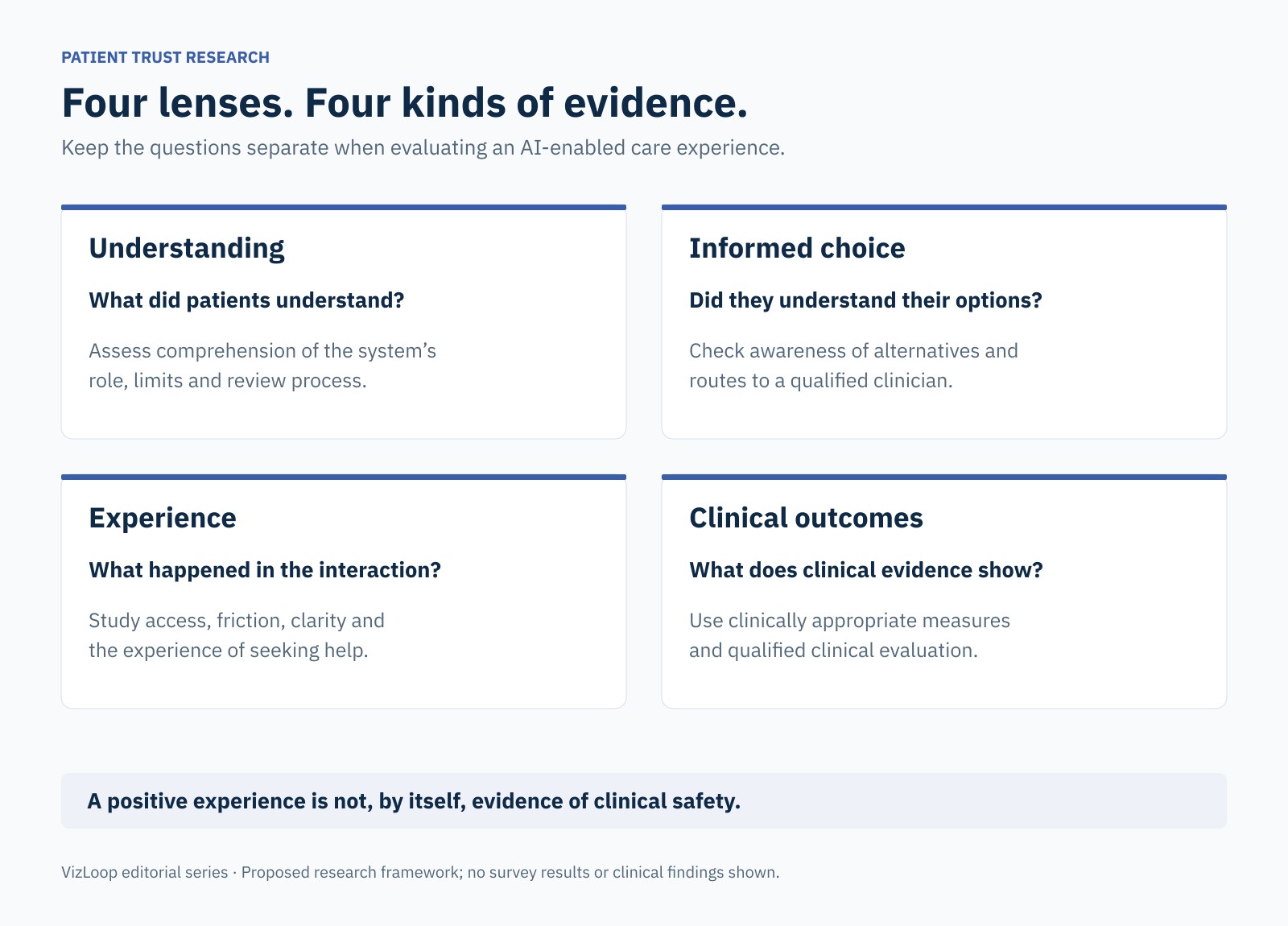
For teams designing research or reviewing patient-facing messaging, four areas deserve separate attention.
Full text of this figure
PATIENT TRUST RESEARCH Four lenses. Four kinds of evidence. Keep the questions separate when evaluating an AI-enabled care experience. Understanding What did patients understand? Assess comprehension of the system’s role, limits and review process. Informed choice Did they understand their options? Check awareness of alternatives and routes to a qualified clinician. Experience What happened in the interaction? Study access, friction, clarity and the experience of seeking help. Clinical outcomes What does clinical evidence show? Use clinically appropriate measures and qualified clinical evaluation. A positive experience is not, by itself, evidence of clinical safety. VizLoop editorial series · Proposed research framework; no survey results or clinical findings shown.
Understanding
Can a patient explain the process after reading the disclosure?
Useful questions include:
- Which parts of the assessment use AI?
- Does a clinician review my case before a prescription is sent?
- Which conditions and treatments are outside this service?
- What happens if the service cannot handle my case?
Test understanding in the patient’s own words. Showing a disclosure or recording an acknowledgment does not establish that its meaning was understood.
Also test the language used to describe regulatory status. A state-authorized pilot should not be described as proof that the state endorses the technology. Utah expressly distinguishes participation in its sandbox from state endorsement or certification. Utah’s explanation of pilot limits
Informed choice
Does the person know how to ask a question, seek human care or leave the process?
Research should examine whether the available routes are understandable and usable, including when the AI cannot continue. Review the experience at the point where a patient needs help, rather than relying only on a link in the terms.
Do not treat completion of the workflow as a direct measure of trust. Someone’s decision to continue could reflect several factors. Research needs to ask why, rather than assigning a motive from usage data.
Experience
What happened during the interaction, and how did the patient interpret it?
Ask whether explanations were clear, whether uncertainty was acknowledged and whether handoffs worked as described. Include people who stopped, were excluded or were referred elsewhere. Feedback from successful completers alone cannot describe the full experience.
Keep satisfaction, convenience and willingness to use the service again as distinct measures. An overall positive rating can conceal confusion about who reviewed the prescription.
Clinical outcomes
Clinical safety and effectiveness require their own evidence and appropriate clinical evaluation. A high satisfaction score cannot establish either. Nor can agreement between an AI and a reviewing clinician answer every question about patient outcomes.
For the same reason, label alignment in a consumer AI answer cannot establish whether a treatment is right for an individual.
Keep treatment claims precise
Nolla’s agreement includes compounded topical formulations. Communications should not imply that every option is an FDA-approved product. FDA explains that it does not review compounded drugs for safety, effectiveness or quality before marketing. Nolla agreement, medication scope · FDA explanation of compounded drugs
More broadly, reviewers should look for language that stretches a narrow pilot into a promise about all acne care, all patients or all AI prescribing. Specificity about eligibility, review and limitations gives researchers something concrete to test and patients a clearer description to evaluate.
What pharma teams can do now
Use the pilot as a prompt to review the claims surrounding your own patient-facing experiences. Check whether the description of AI matches its actual role, whether human review is described accurately and whether the path to further help is clear.
Separately, inspect how consumer AI services answer questions about your brand and treatment area. An external answer may blend product information, individualized advice and unsupported reassurance. Capture the exact language and route material findings for review.
VizLoop provides dated AI-answer records and versioned FDA label evidence that teams can review alongside their own communications. It does not measure patient trust, validate a prescribing system or establish clinical safety. Patient research and clinical evaluation remain separate work.
Policy details checked October 10, 2026. The research questions above are recommendations, not reported findings from Nolla’s pilot. This article is not medical or legal advice.
Email subscriptions are paused. All posts remain available on the blog.